I’m a survivalist. Not the kind who’s stockpiling a year’s supply of ammo and freeze-dried food in a secure location, prepping for the collapse of Western Civ. I’m not quite that paranoid, yet. But I do know I’m not good in a crisis. I hate surprises and I learned long ago that I have a tendency to panic when things suddenly go south. The only thing that can keep me from losing my head in a tight spot is to have a contingency plan in place to fall back on and to be equipped to cope with even the most unlikely contingency. As a result, I travel with a load of stuff that I haven’t used in years (except for practice) and I am constantly looking for advice from other more experienced outdoorsmen. My latest is Desert Survival Tips at desert usa, one of my favorite websites.
Wildfires
Good news on the fire front. Dog Head is essentially out and North Fire “has shown little activity,” apparently holding at 42,000 acres (although there’s an ominous hint of new smoke in the San Mateos).
Fort Bayard
According to the Grant County Beat they’ve finished tearing down the old Fort Bayard hospital. There’s some photos at the link, and the Silver City Sun-News has covered the demolition over the last couple of months. Normally I mourn the loss of any old building, but to my eye the hospital struck a discordant note on the old parade ground. It was state-of-the-art circa 1950 but looked out of place beside the officers’ quarters that are lined up in quiet dignity along an adjoining face of the parade. It’s been a few years since I visited Fort Bayard but I remember it as an almost surreal experience. It was a beautiful fall day, and I was apparently the only living human on the property, There’s been some attempt to maintain the old buildings, but not so much they appear artificially preserved or reconstructed, and the fort looks pretty much as it did in 1890.
The state was looking for a buyer a couple years ago, but I don’t know whether the hospital demolition is being done by a new owner or the state is doing it to remove a potential environmental obstacle to selling the property. I was tempted to suggest to the Fort Sill Apache that the tribe make an offer. Silver City would be a great place for a casino/hotel/resort like Inn of the Mountain Gods, and there would be a certain historic irony to the acquisition.
Bear Tracks
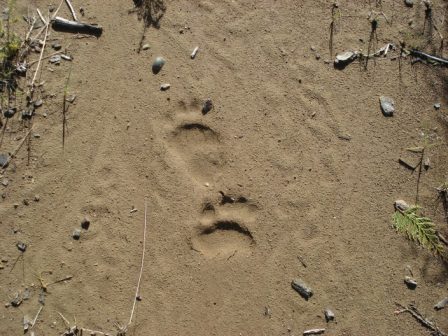
I saw bear tracks up on Alamocita Creek a few weeks ago, close to a waterhole some fool woman was said to be using as an outdoor bathtub, and lately I’ve been noticing reports of bear attacks. Since I frequently hike and camp in bear country, these always catch my eye on the web. A mountain biker killed in Montana was a FS LEO (what we used to call a “tree cop”). Bud Treat and a friend were riding a trail near his home when they surprised a bear. Last I heard it wasn’t clear whether the animal was a Grizzly or a Black, but whichever it was big enough to knock Treat off his bike and kill him.
The other rider, “a relative of Treat’s, whose name was not released, went to get help and was not hurt.” I’ve never been attacked by a bear but I’ve been panicked in the woods, and I know how overpowering the urge to beat feet in a crisis. But he (or she) might have picked fight over flight and used his own bike to distract the bear long enough for Treat to regain his feet. Together the two of them might fought it off.
Story says Treat was also a runner, which brings to mind a recent bear attack in New Mexico. This victim was running in a marathon through the Valles Caldera when she surprised a black sow and her cubs. Why run a race through a wildlife refuge? The Valles Caldera has a history of environmental folly, but this was exceptionally feather-headed even for them. If there’s one thing we have in New Mexico it’s wide-open spaces, so there’s absolutely no reason to send a pack of half-naked humans stampeding through bear country during berry season. If you come running through my pantry I’m going to be both surprised and angry too.
In both these incidents speed was a factor. The human appeared almost without warning in the bear’s “danger close” zone, triggering an event neither had the time or space to avoid. That’s one reason I disapprove of runners and bikers on the trails. Will you people please stay on the pavement? Or at least on a road where you can contend with human-operated vehicles rather than disturbing the wildlife?
It’s too bad they had to kill the mama bear, since she wasn’t at fault and leaves three cubs the rangers will have to round up and take away to be raised in cages. The victim is rightfully sorry for this outcome, although I believe I would be more the Captain Ahab type and regret only they didn’t leave the beast alive until I was up and around so I could kill it myself.
“Connecting Rural New Mexico”
My latest newspaper column is posted at New Mexico News Service.
Cooney’s Tomb
I’ve posted Cooney’s Tomb in the Warpath, although (as usual) I’m not entirely satisfied with my researches into the subject. I’m on my way down to Silver City sometime in next couple of weeks, with a stopoff in Socorro, and I hope to locate one or another of Michael Cooney’s descendants who can fill me in on the family history. In particular I would like to discover what connection if any there was between Capt. Michael Cooney, 9th Cavalry, and Capt. Michael Cooney, brother to James Cooney. If not, it seems an extraordinary coincidence.
North Fire Update
The North Fire in the San Mateos is now up to more than 42,000 acres but about 70% contained. This blaze never rec’d the media coverage the Dog Head fire got at 18,000 acres; the difference of course is Dog Head swept through an area with a scattered human population, burning two dozen homes and forcing the evacuation of nearly 400 people. I was surprised to see video on TV of a woman I used to work with at PNM whose family was among those burned out. I feel for her; as a young reporter I covered too many housefires and know how personally devastating they are. No matter how much insurance you have, it’s painful to see everything you have reduced to ashes.
Michael Herr RIP
A moment to mourn the passing of Michael Herr, one of the very few writers who can claim to be the voice of a generation. His Vietnam War memoir Dispatches was dismissed by some of his peers at the time as semi-fictional and so somehow inauthentic, but it captured the horror, absurdity and pathos of our SE Asia debacle the same way James Jones, Erich Maria Remarque and Stephen Crane captured earlier wars for posterity.
I spent my own military service entrenched behind a desk in the Rhineland, grateful to be there rather than in ‘Nam, but in Herr’s prose I heard the voices of the men I knew who had served there. Like Ernie Pyle and unlike most of the “war correspondent” poseurs in Vietnam, Herr had an ear for dialogue and a genuine empathy for the men (most of them really boys) fighting the war he was covering.
“If somebody were to ask me what it was about, I would say that the secret subject of Dispatches was not Vietnam, but that it was a book about writing a book,” Herr said. “I think that all good books are about writing.”
Dispatches was certainly one of the best works to emerge from the New Journalism wave, which began with Truman Capote and reached its apogee with Tom Wolfe, Hunter Thompson, Joan Didion and a few others before declining into self-conscious parody and irrelevance.
Thompson (who is gone now himself) once said Herr, “puts all the rest of us in the shade.”
Chapter 3 revised
After several weeks of tinkering and hesitation I am reposting Chapter 3, which covers July 19-August 9 (from White Sands through the Datil Mountains). I’ve been looking for more confirmation of my theory that Nana dispatched decoys from the main war party west from Alamocita Creek while the main body of the raiders split into two groups, one riding north and the other northeast. So far I have only Hatch’s report that Guilfoyle had been “thrown off the trail,” newspaper accounts of various depredations in western New Mexico, and Sweeney’s reference to two boys captured during the Raid and later retrieved by their father, who came to San Carlos from Quemado in 1883 to reclaim the captives. None of this is conclusive, but a futile western detour by the troops would explain why Bennett and the scouts were in hot pursuit across the Plains of San Augustin into the Datils on Aug. 3 or 4, but Lt. Wright met Guilfoyle somewhere “north of Monica Spring” five days later, and their combined force didn’t finally arrive at Rancho Cebolla until the evening of Aug. 11., three days after the raiders departed there the morning of August 8. Depending on how long Guilfoyle tarried at Monica Spring to rest his men and horses, it seems to me there’s a day or two missing from the narrative.
Colonel Hatch’s Report
I’ve added Col. Hatch’s report as submitted to Gen. Pope on Oct. 3, 1881, and published in the Annual Report of the Secretary of War for the Year 1881, pp. 126-27, in Sources. As usual, there are contradictions with other accounts, and there are several points on which my own reconstruction of events differs from Hatch’s report. Like everyone else involved, the colonel had his own agenda — his regiment’s reputation as well as his own chance at a general’s star was on the line — but it’s one of the key primary documents on the Raid and should be read in full by anyone interested in these events.