The Opening Shots

Although Nana’s war party is said to have crossed the Rio Grande into Texas on the 13th, the old man didn’t announce his presence in New Mexico until July 17, when his warriors jumped Lt. Guilfoyle’s miniature pack train in Alamo Canyon.  It was the first in puzzling episodes in the raid. How and why the two packers separated, one of them wounded and both presumably afoot, is just one unanswered question about the episode.


El Loco Gringo Viejo

I recently wrote a column on one of my youthful heroes, astronaut Jack Schmitt, and on June 20 we marked the birthday of another boyhood idol who I’ve never written about. But I have my old-age role models as well. Nana is one and another is 19th Century newsman, author and world-class cynic Ambrose Bierce, who would be 175 today if still alive. I say “if” because aside from the standard actuarial tables there’s no reason to suppose he’s deceased. Bierce disappeared into the maelstrom of revolutionary Mexico in 1913 and hasn’t been seen since.

He was 71 years old, severely asthmatic and suffering the usual aches, pains and losses of advancing age, depressed by the deaths of his two sons and his estranged wife. After a tour of the Civil War battlefields he had fought over as as a young man, he crossed the border at Juarez and apparently accompanied Villa’s forces  as they drove south to Ciudad Chihuahua. In his last communication  from that city in December, he closed the letter with, “As to me, I leave here tomorrow for an unknown destination.”

Despite his prickly personality and sarcastic, biting wit, Bierce was not without influential friends and admirers, including long-time boss William Randolph Hearst. Inquiries were made at the time, but the chaotic conditions in northern Mexico made it impossible to conduct anything like a thorough investigation.

Numerous intriguing theories persist to this day. He may be buried in a mass grave at Ojinaga, across the river from Presidio, Texas, or Villa may have had the old man shot in a moment of anger, or Bierce may have ended as god of a tribe in the jungles of Central America. A bronze plaque in the campo santo of a remote village in the Sierra Madre Oriental in Coahuila is said to mark the grave of an old gringo killed by drunken federales. But nobody knows.

In one of his last letters he wrote:

Good bye. If you hear of my being stood up against a Mexican stone wall and shot to rags please know that I think that a pretty good way to depart this life. It beats old age, disease and falling down the stairs. To be a Gringo in Mexico – ah, that is euthanasia!

Disturnell’s Map

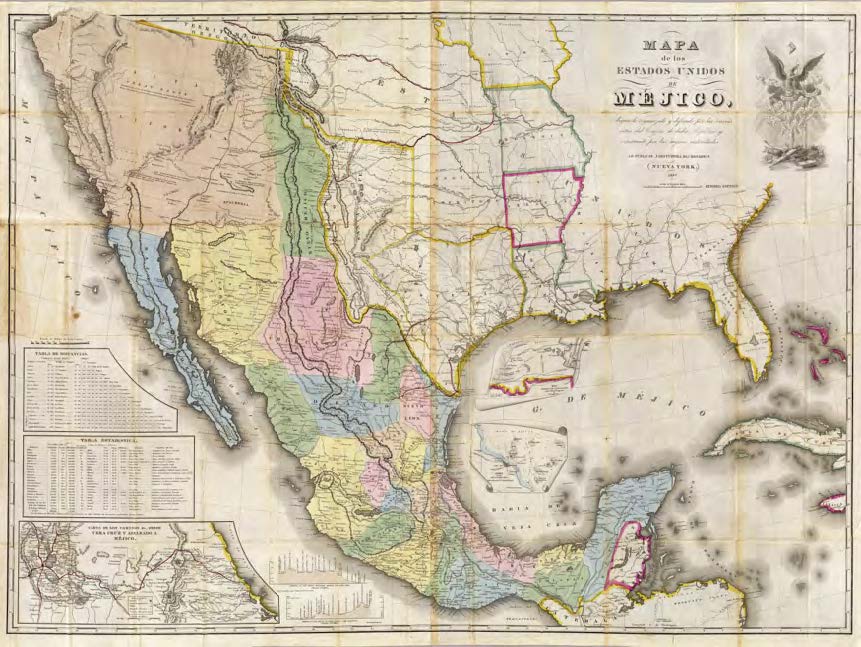
I spent St. Patrick’s Day at the Albuquerque Anitiquarian Books & Maps Fair (highly recommended; I believe it’s the third weekend of every March). Some beautiful maps I would love to own if I had the $ and the space to display them. But I contented myself with just one: a nice copy of Disturnell’s Treaty Map. From Dumont Maps & Books in Santa Fe, it comes with an informative 20-page pamphlet on its provenance.

Disturnell’s 1847 map of Mexico was used in drawing the new international boundary agreed to by the parties to the Treaty of Guadalupe Hidalgo in 1848, and it’s hard to think of another map in American history that caused so much confusion and controversy, leaving a legacy of misunderstanding and ill will that lingers today.

Looking at it, it’s hard to believe this was the most reliable representation the Americans had of the vast territory they had just seized from their southern neighbor. (The Mexicans may have had a better map of their northern domains but chose to base the Treaty negotiations on the Disturnell version because its inaccuracies furthered their own goals.) The controversy over where the real border line lay on the ground continued for five years and was only finally settled by the Gadsden Purchase in 1853.

People new to the history of the Southwest are sometimes surprised to discover that the scar tissue left by that contentious settlement still itches. In a recent emotional (and virulently anti-Trump) NYT op-ed, historian Enrique Krauze argues that the Mexican government has a solid case for nullifying Guadalupe Hidalgo before the International Court of Justice.

Kiser’s Turmoil on the Rio Grande explores the issues as part of the history of the Mesilla Valley in southern New Mexico, and I’ve just picked up Griswold de Castillo’s Treaty of Guadalupe Hidalgo to dig deeper into the subject.

‘Chasing Shadows’

I’m re-reading Hatfield’s Chasing Shadows, an excellent, in-depth history of a century of border disorder as viewed from the Mexican side. It’s a thoroughly researched (and extensively footnoted) work of scholarship with a unique perspective so far as I know. All our popular histories necessarily address the long and bloody conflict in the Southwest from the American point of view. Hatfield draws heavily on primary Mexican sources to provide new insights into incidents like Captain Crawford’s death, as one example. Plus the book places the Apache Wars in the context of all the Indian depredation, banditry, foreign invasion, filibustering and rebellion occurring along the whole length of the border, beginning before the Mexican-American War and continuing into the 20th Century.   Exploring the significance of the Yaqui and Mayo rebellions  in shaping Mexican efforts to suppress the Apache menace really helps in understanding the whole period.

New Mexico 1864

I’ve posted an improved version of a  NM 1864 map drawn by an officer in Carleton’s California Volunteers. Captain Allen Anderson, the cartographer, used more than a dozen earlier maps to draw his detailed map of the Southwest. An 1859 West Point grad and nephew of Col. Robert Anderson of Fort Sumter fame,  Allen L. Anderson  “was Captain in the 5th United States Regular Infantry before being commissioned Colonel and commander of the 8th California Volunteer Infantry regiment. He accompanied the California Column to New Mexico Territory and served there 1861-’62. He was brevetted Brigadier General, US Volunteers on March 13, 1865 for “faithful and meritorious services.” He resigned his Army commission in 1867 and became a civil engineer. He died in 1910, age 73.