Iron Mike

There’s no monument to Jumpin’ Jim I know of. Instead there’s a larger than life size statue in front of Post HQ. Formally titled “The Airborne Trooper” but popularly known as “Iron Mike,” a military slang applied to men who are especially tough, brave, and inspiring. Hearing Gavin’s story and the stories of the men who served with him would have far more positive impact on the average 18-year old recruit than hours of Powerpoint on the “The True Meaning of Liberty” as narrated by some boston college professor.

“Tough times create strong men, strong men create easy times. Easy times create weak men, weak men create tough times.” We need a generation of Iron Mikes,

We need heroes

While other bases are being renamed for Black soldiers, U.S. presidents and “Trailblazing Women”, Bragg is the only post not renamed after a person. The new name was chosen because “liberty remains the greatest American value,” according to one commission member. (Or could be the candidate pool? American combat deaths in World War II: 16 American Women, 708 African American Men, 406,576 White American Men.)

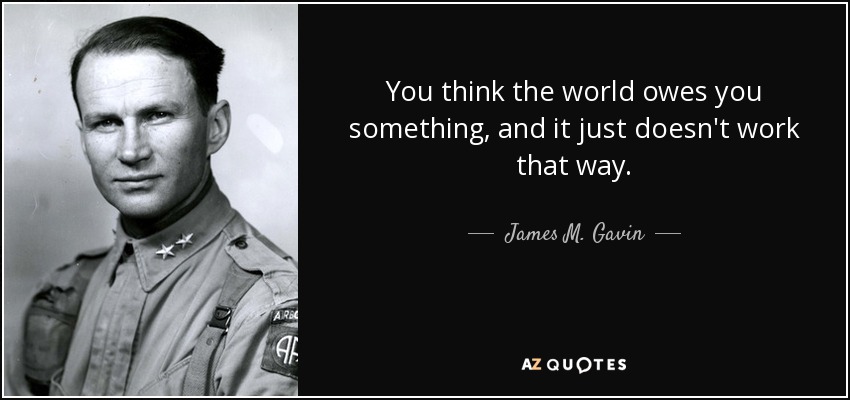
If we might waive the melanin and genitalia rule for the home of the “All American” 82d Airborne, I can suggest no better candidate than Lieutenant General James M. “Jumpin’ Jim” Gavin. Hard to find any traces of White Privilege in his career. Born in a Brooklyn tenement and orphaned at age two, at 9 he was adopted by a coal miner and his wife. At 12 he quit school to work full time to support his foster family, but continued to read every book he could find in his spare time.

He joined the Army at 17, he studied nights and weekends to pass a competitive exam for admission to West Point. As a cadet he got up every morning before reveille to catch up on the required reading and graduated 185th out of a class of 299.

By 1939 he was back at the Point studying the new German Blitzkrieg tactics. Of these the most dramatic was the use of paratroopers. Several other nations were experimenting with the concept, but their focus was on small scale guerrilla raids and harassing tactics. Gavin’s vision was of airborne armies as a major component of a combined arms assault. His first task was writing FM 31-30: Tactics and Technique of Air-Borne Troops. Later, when asked what made his career take off so fast, he would answer, “I wrote the book,”

In 1942 he joined the 82d as commander of one of the division’s parachute regiments. He led his troops on long marches and realistic training sessions, creating the traini’ng missions himself and leading the marches personally. He also placed great value on having his officers “the first out of the airplane door and the last in the chow line.”

His first combat jump was into Sicily, True to his word, he was the first man out the door. He suffered a sprained ankle but pressed on with the fight. His second combat jump was Salerno; his third a night drop into Normandy on D-Day. As 82d commander he led his men into Montgomery’s Market Garden assault on the Bridge Too Far. He suffered two fractured discs on that landing but went on fighting.

The “All Americans” next big fight was in the largest and bloodiest single battle fought by the United States in World War II. On 21–22 December 1944, the 82nd Airborne faced counterattacks from two Waffen SS divisions which included the 1st SS Panzer Division Leibstandarte SS Adolf Hitler and the 9th SS Panzer Division Hohenstaufen. The Waffen SS efforts to relieve Kampfgruppe Peiper failed due to the stubborn defense of the 82nd Airborne, the 30th ID, 2nd ID, and other units.

That spring he and his men drove toward the Rhine, collecting hundreds of thousands of prisoners along the way. He ended the war a 37-year old Lt. General.

.

In Memory of

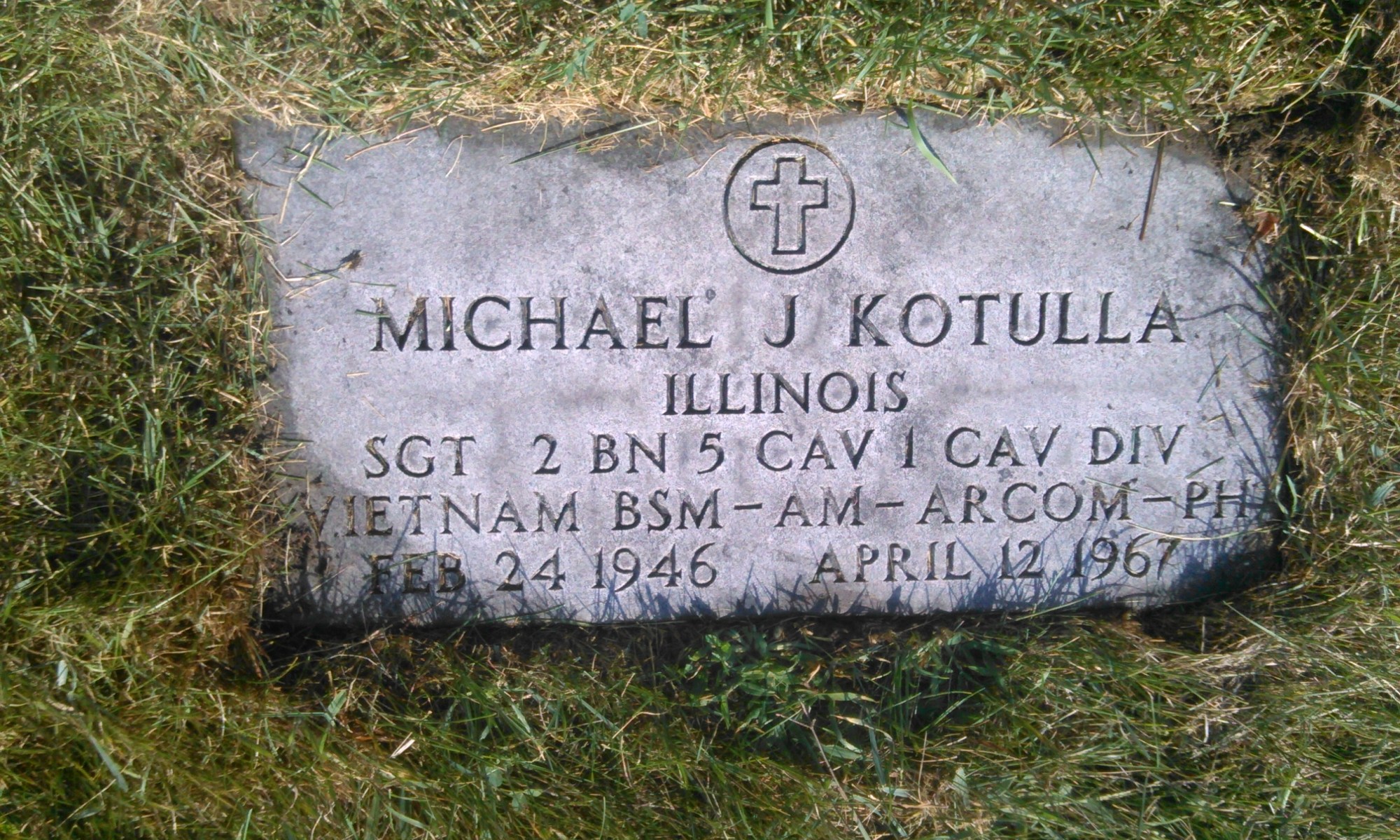
Sgt Michael Jerrard “Mike” Kotulla {RA16809415}, was killed in action from multiple fragmentation wounds on 4-12-1967 while serving as a Light Weapons Infantryman with the 2nd Battalion, 5th Cavalry Regiment, 1st Cavalry Division. He was 21 years old.

lonesome traveler

Well I’m just a lonesome traveler, a great historical bum
Highly educated, through history I have come
I built the Rock of Ages, it was in the year of One
And that’s about the biggest thing that man has ever done

I was born about ten thousand years ago*
There ain’t nothin’ in this world I don’t know
I saw Peter, Paul and Moses playing ring-around-the-roses
And I’ll whup the guy what says it isn’t so

I saw Adam and Eve a-driven from the door
I’m the guy that pick the fig leaves that they wore
And from behind the bushes peeping, saw the apple they were eating
And I’ll swear that I’m the one that et the core

Now, I built the Garden of Eden, it was in the year of Two
Joined the Apple Pickers Union, and I always paid my due
I’m the man that signed the contract to raise the Rising Sun
And that’s about the biggest thing that man has ever done

I taught Samson how to use his mighty hand
I showed Columbus to this happy land
And for Pharaoh’s little kiddies I built all the pyramiddies
And to the Sahara carried all the sand

I was straw boss on the pyramids, and the Tower of Babel too
I opened up the ocean, let the migrant children through
I fought a million battles and I never lost a one
And that’s about the biggest thing that man has ever done

I taught Solomon his little A-B-C’s
I’m the first one that ate Limburger cheese
And while floating down the bay with Methuselah one day
I saw his whiskers floating in the breeze

I fought the Revolution that set this country free
It was me and a couple of Indians that dumped the Boston tea
I won the battle of Valley Forge and the battle of Bully Run
And that’s about the biggest thing that men has ever done

Well, Queen Elizabeth, she fell in love with me
We were married in Milwaukee secretly
But I got tired and shook her and ran off with General Hooker
To go shooting skeeters down in Tennessee


Le Beau Sabreur

Destroying Black Kettle’s village and capturing women and children had certainly worked for Custer on the Washita, and that objective had been explicit in Sheridan’s marching orders on that campaign. General Terry’s orders on this occasion were far more vague and lawyerly, but surprise attacks on Indian villages was the standard operating procedure in the Plains Wars. The Army justified the tactic on the grounds that the rascally redskins wouldn’t stand and fight, leaving the destruction of their villages as the only option if the tribes were to be subdued.

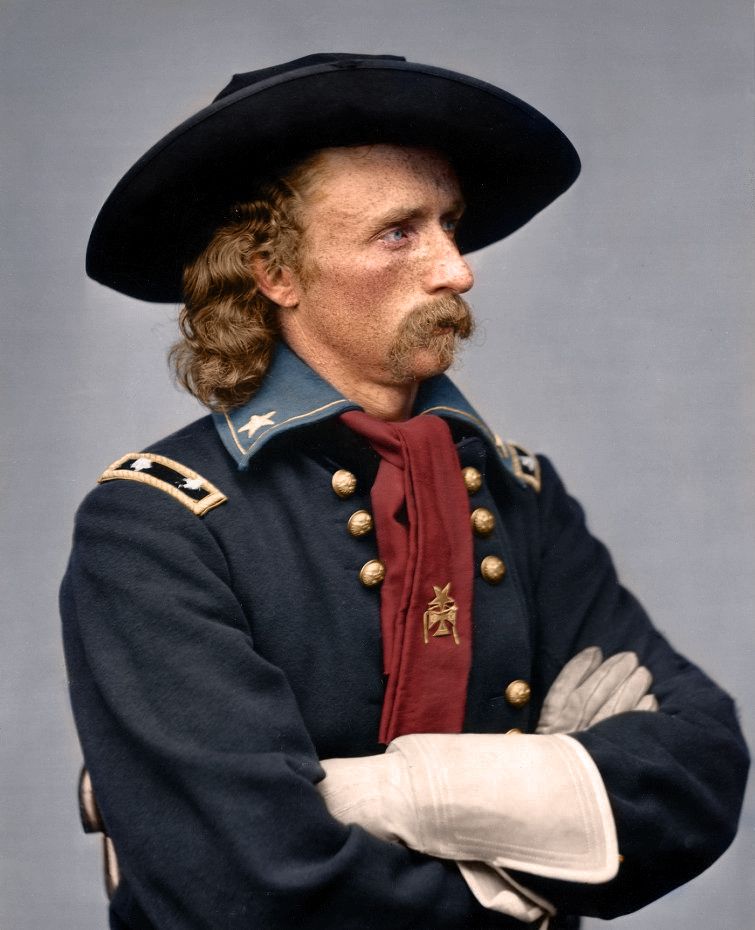
But hiding behind non-combatant hostages to bring the warriors to terms conflicted with Custer’s image of himself as le beau sabreur, a dashing, fearless adventurer in the Napoleonic mold of Lasalle and Davydov. For those bold horsemen the only true role of the cavalry was to attack no matter what the odds, overwhelming the enemy in a sabre-to-sabre l’attaque a outrance.

“L’audace, encore de l’audace, toujours l’audace,” was the motto embraced by these daring cavalrymen, and it had carried Custer to his greatest victories in the Civil War. Given that mindset, I would suggest his plan as he moved up the east side of the river was to launch a flank attack aimed not at the fleeing villagers but falling on the rear of the mass of warriors engaging Reno. His five companies would be the hammer, Reno’s three companies the anvil that would crush the Sioux and Cheyenne braves between them, with Benteen coming up in time to mop up the fleeing survivors.

A complete victory over this huge assembly of their greatest warriors in the open field would finally convince the tribes that resistance was futile. Custer aimed to end the Great Sioux War in one afternoon.

A Seneca Ghost?

Despite his popular moniker John Mosby can be eliminated as Lozen’s “Gray Ghost.” But are there any more likely candidates? As the tale came to Eve Ball, the mysterious stranger who captured young Lozen’s heart was a Seneca warrior. The Seneca homeland was far distant in upper New York, but in 1838 they were swept up in the Great Removal, following the Five Civilized Tribes to Indian Territory.

The Territory was a battlefield from the beginning. The tribes already on the land resented the newcomers, who brought with them their own inter-tribal rivalries and intratribal conflicts. They carried these bitter feuds into the Civil War, dividing the tribes between those who supported the Union and those who believed they might get better treatment from a victorious CSA than they had experienced from the USA. Those who wanted nothing to do with the white man’s war and wished only to rebuild their lives in peace were ridden down, burned out and trampled in the ensuing conflict.

The Seneca were among the tribes allying themselves with the Confederacy, and it’s likely some of their men were among the hundreds of Native Americans to take the field.. The best known is Brigadier General Stand Watie, whose Cherokee Mounted Rifles are renowned for capturing a steamboat on the Arkansas River. Watie, whose Indian name is better translated as “Standfast,” was the last Confederate general to surrender, laying down his arms on June 23, 1865.

Although the war ended, violence and lawlessness continued to plague the Territory for another 30 years. While most Indians stayed to fight for their lands, others moved on still farther from their original homelands. For example, Kickapoo and Potawatomi established villages across the Rio Grande in Mexico. So while the story is improbable, it’s not impossible that a Seneca veteran might have passed through New Mexico Territory “seeking some place where his people would be safe from their many enemies.”

Who Was the “Gray Ghost”?

One Apache story that has always fascinated me is the strange tale of Victorio’s sister Lozen and “the Gray Ghost.”

Lozen was in the first blush of her beauty when a strange man came riding into their territory. He was an Indian but dressed all in gray, escorting a closed carriage. Lozen loved him from the moment she saw him. He stayed with the Chihenne for several nights, asking questions about Apacheria and the country to the west. There was a woman in his closely guarded wagon, but she was rarely glimpsed. Lozen begged her brother to declare her love for the man they called the Gray Ghost, but the stranger said he was seeking some place where his people would be safe from their many enemies and he could not linger. Early one morning the little party rode on, and the Gray Ghost was never heard of again. Lozen never married but went on to become a great warrior, using her Power to defend her People.

In “Apache Voices,” Sherry Robinson dismisses this pretty Victorian melodrama as the invention of a Seneca woman living in El Paso. But what if there was some truth buried beneath all the embroidery? Given her age in the 1880s, it’s not unlikely that Lozen reached womanhood about the time the Civil War was winding up. Could the Ghost have been a Confederate soldier, cast adrift by defeat? There were a great many such men on the roads west in the summer of 1865.

First candidate to come to mind is the original Gray Ghost, Colonel John Singleton Mosby, a daring young cavalry commander in the mold of J.E.B. Stuart and George Custer. Subsequently immortalized in a short-lived 1950s TV series and a later Disney movie, the handsome, dashing Mosby had the honor of being among the last rebels to quit the field, finally laying down his sword nearly three months after Lee’s surrender at Appomattox. Unfortunately for this theory, by December 1865 the former colonel had returned to lawfare in Virginia and so was unavailable for a tour of New Mexico Territory.

Viva Villa!

Certainly an unpopular and even dangerous thing to say today down on the Texas border, where they are reclaiming the bodies of two Americans killed by bandits in Matamoros. But by ironic coincidence March 9 marks the 107th anniversary of the predawn attack on the little town of Columbus, New Mexico, and the adjacent U.S cavalry Camp Furlong by the outlawed bandit and failed revolutionary Pancho Villa.

It’s not clear Villa himself was on the scene or directing the attack from otra de lado, just as there is some uncertainty over whether he was aiming for the 13th Cavalry’s stables and armories, the vault of the local bank (it was still standing forlorn in an empty lot the last time I visited), or the head of the town’s leading merchant, who had cheated the general on an arms deal.

Whatever Villa’s motives, the raid left 17 American soldiers and citizens dead. Public outrage forced revered professional intellectual and passive-aggressive pacifist President Woodrow Wilson to send the Army into Mexico to capture Villa “dead or alive.” If you’re interested in the details, I highly recommend The Great Pursuit.

America faces a much greater threat today from the murderous cartels that have controlled the border for more than a generation, reaping enormous profits from the traffic in illegal immigrants and illicit drugs. We’ve ignored that underlying problem in our endless arguments over immigration and border security, but it’s past time both governments confront the issue –hopefully with more success than Black Jack Pershing (hampered by a hostile Mexican government and a dithering Presidential administration) had in chasing Pancho Villa.

We Still Miss You, Jack

Speaking of the Boomers, today marks the 59th anniversary of the assassination of JFK, an event as traumatic to that generation as 9/11 was to a later. The oldest of us was just 17, seniors in high school and only beginning to become politically aware. But everybody loved John F. Kennedy. He was young and handsome, a war hero with a great smile. He had a classy wife and cute kids. If Eisenhower was everybody’s grandfather, JFK was their dad.

He was an Irish Catholic and so was almost everybody I knew. Today, when we’re as likely to elect a Mormon as a Muslim, it’s hard to believe that a Catholic President was a big deal. But most of all, he had big ideas, and we were ready for big ideas. We were going to the moon!

“We choose to go to the Moon… We choose to go to the Moon in this decade and do the other things, not because they are easy, but because they are hard; because that goal will serve to organize and measure the best of our energies and skills, because that challenge is one that we are willing to accept, one we are unwilling to postpone, and one we intend to win, and the others, too. “

It was a New Frontier! And we, who had spent the last decade watching Westerns on TV and at the Saturday movies, were going to be part of that. Even today, more than 60 years later, reading a sampling of his rhetoric stirs the blood.

And then some nutjob with a cheap rifle shot him in the head.