“Bibliocaust.”

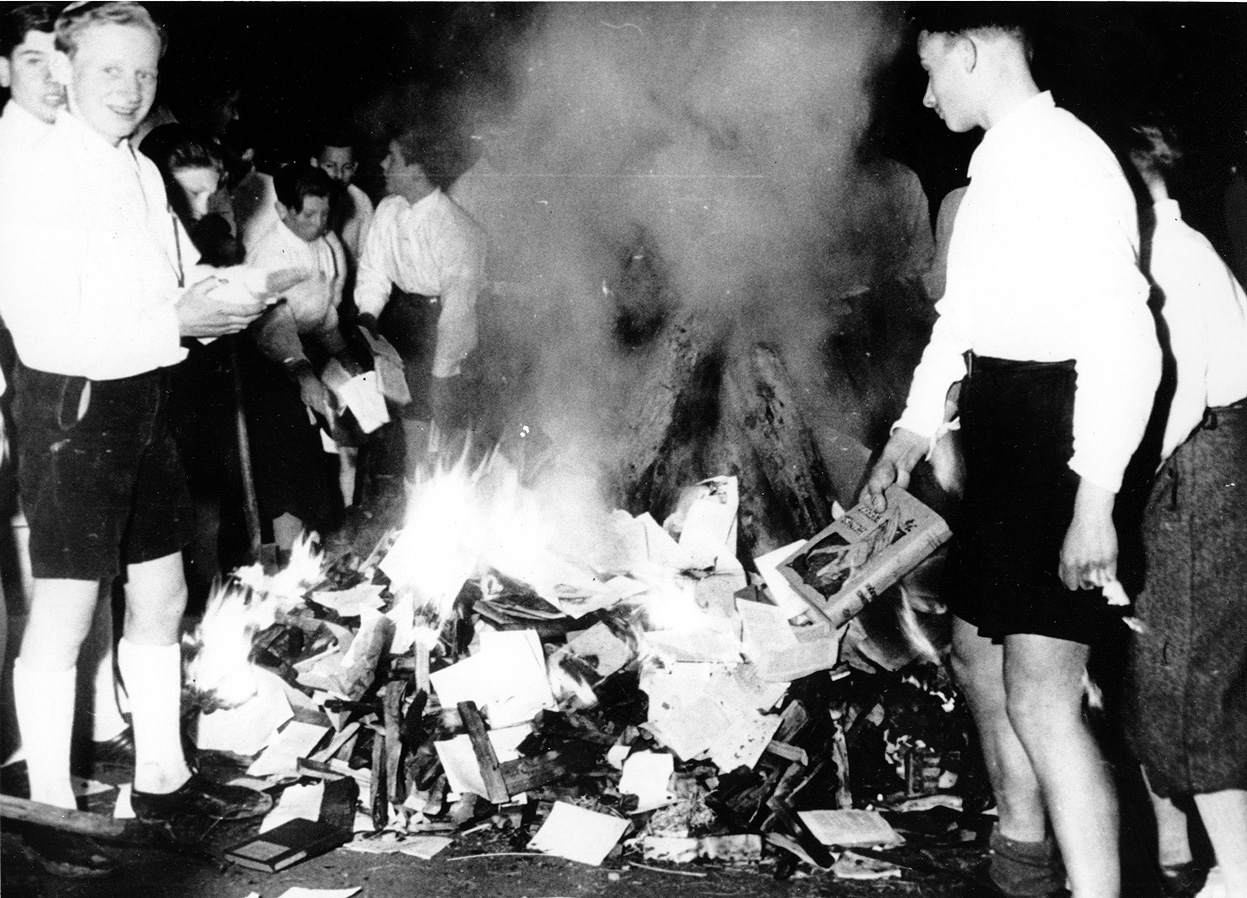
At midnight May 10th, 1933, the National Socialist German Students Union ignited a bonfire. In Berlin, 5,000 torch-bearing teens carried 20,000 books gathered from the city’s libraries, bookstores and private homes to a pyre in Opera Square. The crowd cheered as the works of Erich Maria Remarque, Jack London, Ernest Hemingway, Upton Sinclair and dozens of other American, German, British, French and Russian authors were tossed into the flames.

“German education has been purged of smut and dishonesty,” student leader Herbert Gutjahr declared jubilantly. German youth would no longer suffer the pain of being exposed to ideas they and their leaders disagreed with. (Feel free to enjoy a moment of schadenfreude at news that Herbert was killed on the Eastern Front in 1944. A Christian would pray that before the end he recognized the error of his ways.)

Time magazine called it a “bibliocaust” in eerie presentiment of the holocaust to follow. The German word was Gleichschaltung, the inculcation of the Nazi ethos into every aspect of German life—language, lineage, behavior, and, of course, reading material.

Another very tough old man

My obsession with historic monuments and their cultural significance sidetracked my last post, which turned into a defense of the “Minuteman” statue. But what I set out to do on the anniversary of the opening clashes of the American Revolution was to recall the story of yet another old man in the mold of Nana.

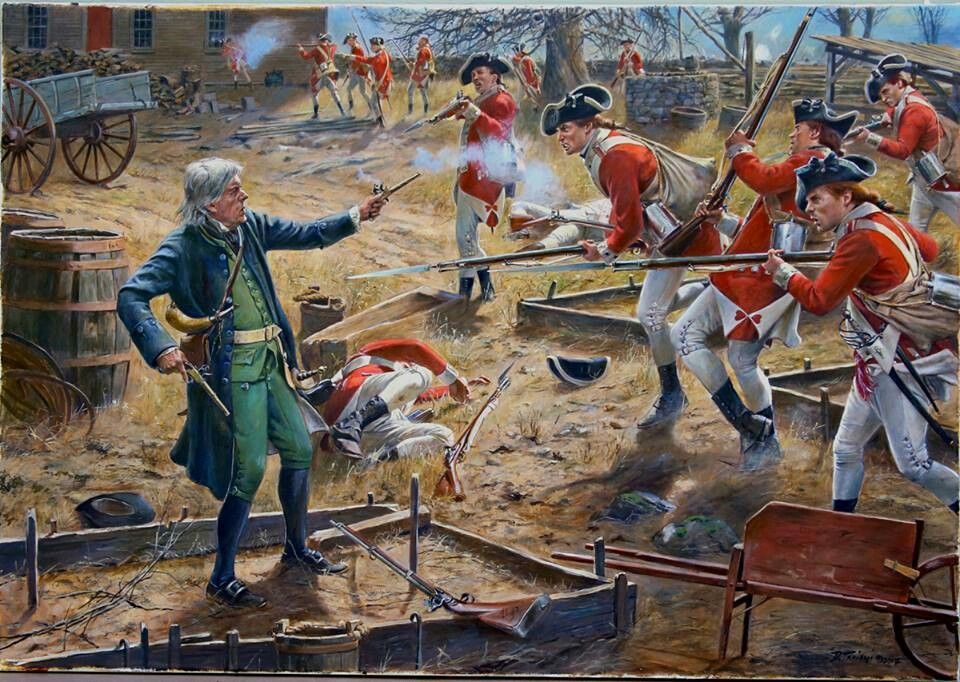
Sam Whittemore fought for the crown in King George’s War (1744-48) and the later French and Indian War (1754-63). He retired a captain of dragoons and settled on a farm in Massachusetts to enjoy his golden years.

He was 80 years old when the King’s men showed up in his dooryard. Humiliated by their repulse at Concord and infuriated by the sniping that was thinning their ranks as they retreated to Boston, the redcoats revenged themselves on the countryside as they went, burning and plundering farms along the line of march and shooting suspected rebels on the spot.

Although far too old to have any obligation to militia service, Captain Whittemore picked up his musket, added a brace of dueling pistols and a cutlass (a souvenir of his service against the French) and went out to contest these outrages. He took his stand behind a stone wall and opened fire on the King’s 47th Regiment of Foot.

He killed one soldier with his musket and then killed another and mortally wounded a third with his pistols as the grenadiers charged the ambush, then fended off their bayonets with his cutlass until shot in the face. As he struggled to regain his feet, the redcoats clubbed him down with their gun butts and bayoneted him on the ground. They left him for dead by the roadside, but when his neighbors came to collect the body they found the old man up on one knee, reloading his musket.

A local doctor could do no more than bandage the captain’s 13 stab wounds and the bullet wound to his head before sadly ordering him carried home so that he might die surrounded by his family. Instead, the tough old soldier recovered and lived another 18 years before dying at age 98. I’d love to see Clint Eastwood play him in the biopic.

That memory may their deed redeem,

Wonder why we struggle to preserve old monuments? Emerson got it:

On this green bank, by this soft stream,

    We set to-day a votive stone;

That memory may their deed redeem,

    When, like our sires, our sons are gone.

Spirit, that made those heroes dare

    To die, and leave their children free,

Bid Time and Nature gently spare

    The shaft we raise to them and thee.

Today’s an anniversary little remembered or honored in history classes where the lessons focus on the sins of our forefathers instead of their virtues. But the clashes at first Lexington and then Concord and back to Boston (the British regulars carried the first but lost the second catastrophically once the Americans learned a hard lesson: the best way to confront a red coat was from behind a bush) were pivotal in the history of the world. When Washington heard the news he wrote: “The once happy and peaceful plains of America are either to be drenched in blood or inhabited by slaves. Sad alternative! But can a virtuous man hesitate in his choice?”

The resolute farmer clutching his musket in one hand and resting the other on a plow was sculpted by Daniel Chester French and cast from the metal of Civil War cannons on the centenary of those first fateful skirmishes of the American Revolution.

The Earth is Weeping

I’ve been a compulsive reader ever since I struggled past the banality of Dick and Jane and discovered the wider world of literature. I’m usually immersed in two or three books at a time, dipping into first one and then the other as my inclination directs. Some books are just too difficult to digest without an occasional divergence into less demanding reading.

One I’m currently struggling with is The Earth is Weeping. Cozzens’ accounts of the Great Sioux War, the Modoc War, the Nez Perce’ anabasis and the Victorio War make painful reading. The courage, self-sacrifice and stubborn determination displayed on both sides of the conflict cannot redeem the cynicism, greed and bureaucratic indifference that precipitated so much bloodshed.

Henneman’s History Podcast

I can’t say I’m a fan of podcasts in general, if for no other reason that it sounds an ugly and madeup word. But this series on American history comes highly recommended. I’ve just started it so I can’t vouch for the entirety, but I found myself nodding in complete agreement with the opening segment.

Black Jack

There have been a pair of Black Jacks in the Army. The latest was John J. Pershing. There used to be a statue of him shaking hands with Pancho Villa in a little plaza in Palomas, but I haven’t been down there in years and can’t guess if it’s still there.

The first was John A. Logan, a Civil War general known to his troops as Black Jack for his “swarthy” good looks. (Can you still use that word or is it now considered pejorative? Looking at his picture I would have called him “Black Irish,” although I know nothing of his heritage but his name.)

His equestrian statue stands in Chicago but may be riding off into the sunset in the near future, depending on how quickly the wheels of Social Justice grind. Logan’s is one of more than 40 works of public art the Chicago Monuments Project finds worthy of discussion.

Black Jack Logan was a hero. As a sitting Congressman, he might have watched First Bull Run with the other feckless picnickers on the heights above the battlefield. Instead he joined the fight as an “unattached volunteer” with a Michigan militia regiment. From Virginia he rode west to campaign under U.S.Grant, where he had his horse shot from underneath him at the Battle of Belmont and was wounded himself at the taking of Fort Donelson. While recuperating he resigned his Congressional seat and returned to Illinois to raise a regiment for the Union.

He commanded a division at Vicksburg and a corps at Atlanta. In the final months of the war, Logan led the XV Corps on Sherman’s destructive march through the Carolinas, a campaign which freed tens of thousands of jubilant slaves.

Unfortunately, “recent scholarship” has unearthed evidence that despite shedding blood for the Union and personally freeing thousands of slaves, Black Jack was a pre-War Democrat and political supporter of Illinois Senator Stephen A. Douglas and so was “insensitive to the moral repugnance of slavery” or even “proslavery.”

It’s true that Douglas, the northern Democrat who ran against Lincoln in 1860, was opposed to abolition on the grounds that it would ruin the Southern economy and very probably lead to secession and bloodshed. Logan had grave forebodings that a sudden influx of uneducated and impoverished former slaves into Northern cities would foster not integration but generations of racial friction.

As it turns out, they were both right.

Ronald Reagan warned of the consequences of not educating Americans in their history:

“If we forget what we did, we won’t know who we are. I am warning of an eradication of the American memory that could result, ultimately, in an erosion of the American spirit. Let’s start with some basics: more attention to American history and a greater emphasis on civic ritual.”

The End of America

The America was launched at Newport News on 31 August 1939, just one day before the Nazi invasion of Poland put an end to the North Atlantic passenger trade she was designed to serve. Instead, as the USS West Point she carried 350,000 men to the battlefields in Europe and the South Pacific and then joined in the triumphant Magic Carpet voyages that brought 8 million men home to their families. Discharged in 1946 with two campaign medals (European-African-Middle Eastern and Asiatic Pacific) as well as the American Defense Service and World War II Victory medals, she was freed to resume her original name and her planned career.

The 1950s were the glamorous sunset of the Atlantic run, when Monroe and Russell pursued their amorous adventures aboard a luxurious liner. Although neither as large as her sister United States or the Queens of the trade – the Cunard’s Mary and Elizabeth – many found America’s lines cleaner and more graceful, and she did a good business flying the American flag on the run from New York to Cobh, LeHavre and Bremerhaven.

But when you could jet comfortably across the Atlantic in a matter of hours while a sea voyage took days the liners suddenly found themselves obsolete. SS America changed hands, names and flags in a long downward slide.  New owners subdivided cabins and added bunks to increase passenger capacity and she found a new niche carrying emigrants from England to Australia and New Zealand, but that trade dried up too in the 1970s.

Greek owners renamed her America but failed to make her a cruise ship. There were too many new Love Boats designed to offer the fun the customers wanted.

In 1993 new owners devised a plan to turn the old ship into a floating hotel at the appropriately named port of Phuket in Thailand. Renamed the American Star – although the owners did not trouble to paint out the old names on her bows and stern – her propellers were removed, the bridge painted a bright orange and a Ukrainian tug towed her out of a Greek harbor.

In a storm and heavy seas in the Atlantic the old liner shook off her towlines and floated free until the wind and waves drove her onto a rocky beach in the Canary Islands. Over the next decade the locals, tourists and fascinated observers on Google Earth watched the remorseless surf break the old ship apart. The last remnant of her forecastle finally disappeared beneath the waves in 2013.

“I have but one lamp…

Strange that a choleric Scots-English tobacco farmer could have anything in common with an Apache warrior. But I think Patrick Henry and Nana would have understood each other very well. Today marks the anniversary of Henry’s eloquent address to the Virginia legislature .

“I have but one lamp by which my feet are guided; and that is the lamp of experience. I know of no way of judging of the future but by the past,” Henry told the assembly.

“Our petitions have been slighted; our remonstrances have produced additional violence and insult; our supplications have been disregarded… If we wish to be free, if we mean to preserve inviolate those inestimable privileges for which we have been so long contending, if we mean not basely to abandon the noble struggle in which we have been so long engaged and which we have pledged ourselves never to abandon until the glorious object of our contest shall be obtained, we must fight! I repeat it, sir, we must fight!

“Is life so dear, or peace so sweet, as to be purchased at the price of chains and slavery? Forbid it, Almighty God! I know not what course others may take; but as for me, give me liberty or give me death!”

Worth Dying For

I can’t honestly recommend a book I haven’t read yet, but I’m going to put Things Worth Dying For on order just based on this blurb: “He points to our longing to live and die with meaning as the key to our search for God, our loyalty to nation and kin, our conduct in war, and our service to others.”

Made me think of Nana.

The Revel

More verse, this poem ominously quoted in Dracula:

We meet ’neath the sounding rafter,
And the walls around are bare;
As they shout back our peals of laughter
It seems that the dead are there.
Then stand to your glasses, steady!
We drink in our comrades’ eyes:
One cup to the dead already—
Hurrah for the next that dies!