One last “Gray Ghost”

Can’t leave the “Gray Ghost” theme without a nod to Bryan Reinhardt, a Texan entrepreneur who invented a mechanical method to produce large, beautifully shaped “spear points” from slabs of Edwards Plateau Chert. Beginning shortly after WWII, Reinhardt sold thousands of these faux artifacts to souvenir stands, rock shops and tourist traps along Route 66 from Oklahoma to California.

Known as “gray ghosts” for the characteristic gray-brown color of the rock they were cut from, the points resemble genuine archaic finds. The illusion of age was created by lightly buffing the surface and adding a coating of dirt. Reinhardt sold his creations in gross lots and there’s no evidence he ever intended to mislead his wholesale customers as to their provenance. But a great many unwary tourists doubtless purchased the blades at inflated prices under the impression they were acquiring a genuine prehistoric artifact, and Reinhardt’s “ghosts” occupy a pride of place in arrowhead collections all over the country today.

A Seneca Ghost?

Despite his popular moniker John Mosby can be eliminated as Lozen’s “Gray Ghost.” But are there any more likely candidates? As the tale came to Eve Ball, the mysterious stranger who captured young Lozen’s heart was a Seneca warrior. The Seneca homeland was far distant in upper New York, but in 1838 they were swept up in the Great Removal, following the Five Civilized Tribes to Indian Territory.

The Territory was a battlefield from the beginning. The tribes already on the land resented the newcomers, who brought with them their own inter-tribal rivalries and intratribal conflicts. They carried these bitter feuds into the Civil War, dividing the tribes between those who supported the Union and those who believed they might get better treatment from a victorious CSA than they had experienced from the USA. Those who wanted nothing to do with the white man’s war and wished only to rebuild their lives in peace were ridden down, burned out and trampled in the ensuing conflict.

The Seneca were among the tribes allying themselves with the Confederacy, and it’s likely some of their men were among the hundreds of Native Americans to take the field.. The best known is Brigadier General Stand Watie, whose Cherokee Mounted Rifles are renowned for capturing a steamboat on the Arkansas River. Watie, whose Indian name is better translated as “Standfast,” was the last Confederate general to surrender, laying down his arms on June 23, 1865.

Although the war ended, violence and lawlessness continued to plague the Territory for another 30 years. While most Indians stayed to fight for their lands, others moved on still farther from their original homelands. For example, Kickapoo and Potawatomi established villages across the Rio Grande in Mexico. So while the story is improbable, it’s not impossible that a Seneca veteran might have passed through New Mexico Territory “seeking some place where his people would be safe from their many enemies.”

Who Was the “Gray Ghost”?

One Apache story that has always fascinated me is the strange tale of Victorio’s sister Lozen and “the Gray Ghost.”

Lozen was in the first blush of her beauty when a strange man came riding into their territory. He was an Indian but dressed all in gray, escorting a closed carriage. Lozen loved him from the moment she saw him. He stayed with the Chihenne for several nights, asking questions about Apacheria and the country to the west. There was a woman in his closely guarded wagon, but she was rarely glimpsed. Lozen begged her brother to declare her love for the man they called the Gray Ghost, but the stranger said he was seeking some place where his people would be safe from their many enemies and he could not linger. Early one morning the little party rode on, and the Gray Ghost was never heard of again. Lozen never married but went on to become a great warrior, using her Power to defend her People.

In “Apache Voices,” Sherry Robinson dismisses this pretty Victorian melodrama as the invention of a Seneca woman living in El Paso. But what if there was some truth buried beneath all the embroidery? Given her age in the 1880s, it’s not unlikely that Lozen reached womanhood about the time the Civil War was winding up. Could the Ghost have been a Confederate soldier, cast adrift by defeat? There were a great many such men on the roads west in the summer of 1865.

First candidate to come to mind is the original Gray Ghost, Colonel John Singleton Mosby, a daring young cavalry commander in the mold of J.E.B. Stuart and George Custer. Subsequently immortalized in a short-lived 1950s TV series and a later Disney movie, the handsome, dashing Mosby had the honor of being among the last rebels to quit the field, finally laying down his sword nearly three months after Lee’s surrender at Appomattox. Unfortunately for this theory, by December 1865 the former colonel had returned to lawfare in Virginia and so was unavailable for a tour of New Mexico Territory.

Viva Villa!

Certainly an unpopular and even dangerous thing to say today down on the Texas border, where they are reclaiming the bodies of two Americans killed by bandits in Matamoros. But by ironic coincidence March 9 marks the 107th anniversary of the predawn attack on the little town of Columbus, New Mexico, and the adjacent U.S cavalry Camp Furlong by the outlawed bandit and failed revolutionary Pancho Villa.

It’s not clear Villa himself was on the scene or directing the attack from otra de lado, just as there is some uncertainty over whether he was aiming for the 13th Cavalry’s stables and armories, the vault of the local bank (it was still standing forlorn in an empty lot the last time I visited), or the head of the town’s leading merchant, who had cheated the general on an arms deal.

Whatever Villa’s motives, the raid left 17 American soldiers and citizens dead. Public outrage forced revered professional intellectual and passive-aggressive pacifist President Woodrow Wilson to send the Army into Mexico to capture Villa “dead or alive.” If you’re interested in the details, I highly recommend The Great Pursuit.

America faces a much greater threat today from the murderous cartels that have controlled the border for more than a generation, reaping enormous profits from the traffic in illegal immigrants and illicit drugs. We’ve ignored that underlying problem in our endless arguments over immigration and border security, but it’s past time both governments confront the issue –hopefully with more success than Black Jack Pershing (hampered by a hostile Mexican government and a dithering Presidential administration) had in chasing Pancho Villa.

Save the Oompa-Loompas

While I’m on the subject of cultural vandalism, can I add my small voice in defense of Roald Dahl and his endearing works? The idea that the owner of the copyright can edit and revise the work of a deceased author may be legal but it’s certainly not ethical. That Amazon can then reach out and retroactively bowdlerize the Kindle copies that silly consumers thought they already owned is even more outrageous. I’m saddened but not surprised that every living author, writer, reporter, blogger and cartoonist has not spoken out in protest, just as no sculptor has protested the iconoclasm defacing and destroying the works of their predecessors in recent years.

Not Dilbert!

I’ve posted in the past in defense of Pepe Le Pew, General “Black Jack” Logan, Davy Crockett and R.E.Lee, and I have little to add today to those comments, except to note all those men as well as that sexist skunk were (I thought) past our power to harm. Today I’m defending a living artist. To dismiss him as a mere “cartoonist” and so justify leaving him to the wolves while we continue our mad race to cultural extinction entirely misses the point. Breaking a man’s rice bowl because you disagree with what he says is fundamentally un-American.

We Still Miss You, Jack

Speaking of the Boomers, today marks the 59th anniversary of the assassination of JFK, an event as traumatic to that generation as 9/11 was to a later. The oldest of us was just 17, seniors in high school and only beginning to become politically aware. But everybody loved John F. Kennedy. He was young and handsome, a war hero with a great smile. He had a classy wife and cute kids. If Eisenhower was everybody’s grandfather, JFK was their dad.

He was an Irish Catholic and so was almost everybody I knew. Today, when we’re as likely to elect a Mormon as a Muslim, it’s hard to believe that a Catholic President was a big deal. But most of all, he had big ideas, and we were ready for big ideas. We were going to the moon!

“We choose to go to the Moon… We choose to go to the Moon in this decade and do the other things, not because they are easy, but because they are hard; because that goal will serve to organize and measure the best of our energies and skills, because that challenge is one that we are willing to accept, one we are unwilling to postpone, and one we intend to win, and the others, too. “

It was a New Frontier! And we, who had spent the last decade watching Westerns on TV and at the Saturday movies, were going to be part of that. Even today, more than 60 years later, reading a sampling of his rhetoric stirs the blood.

And then some nutjob with a cheap rifle shot him in the head.

A Lament for the Boomers

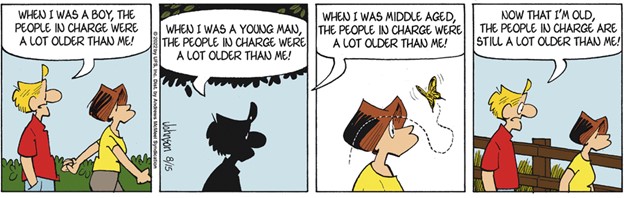
I posted Kipling’s Recessional a few days ago because I was thinking about the passing of the Boomers, which seems to me as significant a generational transition. While Victoria’s Diamond Jubilee celebrated her reign over a global empire of 450 million people, Kipling recognized that the vigorous, self-confident generation that had built that empire was fading away. The coming generation would be caretakers, not empire builders, and the Pax Brittanica could not endure. He lived to see the truths of the Victorians collapse in the horror of the First World War.

As Churchill put it in My Early Life, “Scarcely anything material or established which I was brought up to believe was permanent and vital, has lasted. Everything I was sure or taught to be sure was impossible, has happened.”

It remains to be seen whether the Boomers leave behind a worse mess than the Edwardians.